
Manual Handling Training Course Options

Classroom Training Course:
Onsite or Local Training Room
Tutored Course & Practical Assessment

Live Remote Instructor Course:
Video Conference Meeting
Tutored Course & Practical Assessment

Blended Learning Course:
E-Learning Theory Training
Tutored Practical Assessment

E-Learning Course:
E-Learning Theory Training
No Practical Assessment
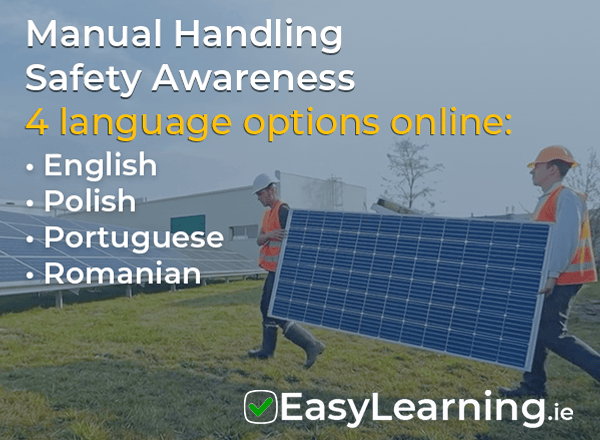
Manual Handling Safety Awareness
Manual handling is a physical activity that takes place in every workplace and training is a legal requirement in Ireland, for all workers who manually move loads, and engage in any activity defined as a manual handling task by the HSA.
Our manual handling course can be delivered on-site or in a local classroom setting, in a blended learning format with e-learning and practical assessment to follow, or delivered by one of our tutors through a video conference TEAMS meeting, which includes a remote practical assessment for immediate certification.
Trainees who complete the e-learning course without practical assessment (those who supervise/risk assess manual handling tasks) are awarded a Manual Handling Safety Awareness Certificate.
Performing manual handling tasks that involve working in awkward postures, or that require repetitive motions can result in injury. These unfavourable ergonomic conditions produce the largest percentage of back injuries and musculoskeletal disorders.
Manual handling related injuries make up around 33% of all reported workplace injuries.
All manual handling injuries are preventable. That is why manual handling training is a legal requirement.
Course Modules Include:
- What is Manual Handling?
- Legislation – Legal Requirements in Ireland
- Anatomy & Back Care
- Biomechanics
- Ergonomics
- Risk Assessment
- Mechanical Equipment
- Principles of Safe Moving
- Skills Demonstration
- Practical assessment
What is a Manual Handling Task?
The HSA defines a manual handling task as the movement of a load which poses a risk of injury – particularly to the back.
The risk can be due to unfavourable ergonomic conditions, the characteristics of the load or a combination of the two.
The characteristics of a load that make moving it a manual handling task include heavy, bulky and unstable loads.
Unfavourable ergonomic conditions include; loads positioned at low or high levels, when the use of stairs is involved in carrying out the task, moving loads over long distances, repetitive movements and working in awkward postures.
Workplace Hazards
Manual Handling is a physical activity that takes place in every workplace. In some cases the activity does not pose a problem. However it can be a potential workplace hazard when an employee is required to handle heavy, bulky, unstable or difficult loads. Performing manual handling tasks in unfavourable ergonomic conditions can result in a back injury. Unfavourable ergonomic conditions produce the largest percentage of back injuries and musculoskeletal disorders (MSD).
Avoid or Reduce Risks:
It is necessary to carry out a risk assessment of existing manual handling tasks before making an informed decision on which tasks need to be avoided or reduced. Employers must then take steps to avoid or reduce the risk of injury. The main concern with manual handling activity is the increased risk of injury due to wear and tear on the back. Back injuries are painful and reduce mobility, they can also lead to long absences from work.